Europe
Main projects
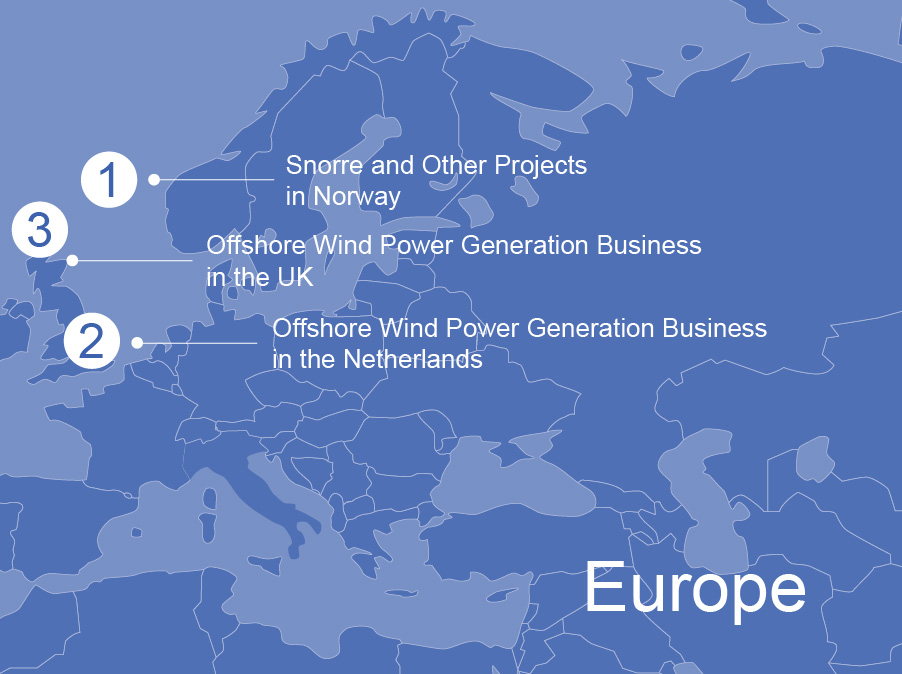
Snorre and Other Projects in Norway
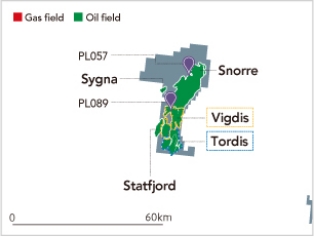
Snorre Project
| Contract area (block) |
Project status | Venture company (established) |
Interest owned (*Operator) |
|---|---|---|---|
| PL057 | In production (Snorre) | INPEX Idemitsu Norge AS (September 25, 1989) |
INPEX Idemitsu Norge AS 9.6% Equinor* 31.0% Petoro 30.0% Wintershall Dea 24.5% Vår 4.9% |
| PL089 | In production (Snorre, Tordis, Vigdis, Statfjord Øst, Sygna) | INPEX Idemitsu Norge AS 9.6% Equinor* 41.5% Petoro 30.0% Vår 16.1% Wintershall Dea 2.8% |
In January 2022, INPEX acquired 50.5% of shares in Idemitsu Snorre Oil Development Co., Ltd. (new corporate name: INPEX Norway Co., Ltd.), which had been held by Idemitsu Kosan Co., Ltd. and Osaka Gas Summit Resources Co., Ltd. Through its wholly owned Norwegian subsidiary INPEX Idemitsu Norge AS (IIN), INPEX Norway currently owns 10 oil and gas assets in production, including the Snorre Project, as well as interests in multiple promising discovered but undeveloped oil and gas fields and exploration licenses. The new addition is expected to help optimize INPEX’s upstream business portfolio.
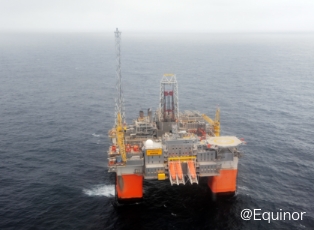
The Snorre Project, IIN’s flagship asset, is drawing approximately 35% of the electricity required for the production operations from the Hywind Tampen floating wind farm.
Other projects
| Contract area (block) |
Project status | Venture company (established) |
Interest owned (*Operator) |
|---|---|---|---|
| PL090, PL090E |
In production (Fram) | INPEX Idemitsu Norge AS | INPEX Idemitsu Norge AS 15% *Equinor 45.0% Vår 25.0% Neptune 15.0%% |
| PL090B | In production (Byrding) | INPEX Idemitsu Norge AS 15% *Equinor 70.0% Neptune 15.0% |
|
| PL090G | In production (Fram H-Nord) | INPEX Idemitsu Norge AS 40% *Equinor 45.0% Neptune 15.0% |
|
| PL090C | In production (Vega) | INPEX Idemitsu Norge AS 15% *Wintershall Dea 45.0% Spirit 25.0% Neptune 15.0% |
|
| PL636, PL636B, PL636C |
In production (Duva), under exploration | INPEX Idemitsu Norge AS 30% *Neptune 30.0% PGNiG 30.0% Sval 10.0% |
|
| PL537, PL537B |
Development scenario studies ongoing (Wisting) | INPEX Idemitsu Norge AS 10% *Equinor 35% Lundin 35% Petoro 20% |
|
| PL882, PL882B |
Under development study (Dugong), under exploration | INPEX Idemitsu Norge AS 20% *Neptune 45.0% Petrolia NOCO 20.0% Concedo 15.0% |
|
| PL090I | Under development study (Blasto), under exploration | INPEX Idemitsu Norge AS 15% *Equinor 45.0% Vår 25.0% Neptune 15.0% |
|
| PL090JS | Under development study (Grosbeak) | INPEX Idemitsu Norge AS 40% *Equinor 40.0% Neptune 15.0% Wellesley 5.0% |
|
| PL293B, PL293CS |
Under development study (Kveikje, etc.), under exploration | INPEX Idemitsu Norge AS 10% *Equinor 51.0% DNO 29.0% Longboat 10.0% |
|
| PL318, PL318B, PL318C |
Under development study (Peon) | INPEX Idemitsu Norge AS 20% *Equinor 60.0% Petoro 20.0% |
|
| PL609, PL609B, PL609D |
Under development study (Alta, Neiden) | INPEX Idemitsu Norge AS 15% *Lundin 55.0% Wintershall Dea 30.0% |
|
| PL090F | Under exploration | INPEX Idemitsu Norge AS 40% *Equinor 45.0% Neptune 15.0% |
|
| PL090HS | INPEX Idemitsu Norge AS 15% *Equinor 45.0% Other 40% |
||
| PL1133 | INPEX Idemitsu Norge AS 10% *Lundin 35.0% Other 55% |
||
| PL1153 | INPEX Idemitsu Norge AS 30% *Aker BP 40.0% Other 30% |
||
| PL1170 | INPEX Idemitsu Norge AS 10% *Lundin 35.0% Other 55% |
||
| PL1130 | INPEX Idemitsu Norge AS 60% *Other 40.0% |
||
| PL1016 | INPEX Idemitsu Norge AS 40% *OMV 60.0% |
||
| PL1129 | INPEX Idemitsu Norge AS 30% *Wintershall Dea 40.0% Lundin 30.0% |
||
| PL1179 | INPEX Idemitsu Norge AS 15% *Equinor Energy AS 45% Vår Energi ASA 25% Neptune Energy Norge AS 15% |
||
| PL1194 | INPEX Idemitsu Norge AS 30% *OOMV(Norge) AS 40% Vår Energi ASA 30% |
Offshore Wind Power Generation Business in the Netherlands
| Contract area (block) |
Project status | Venture company (established) |
Shareholders |
|---|---|---|---|
| Luchterduinen (Q10) | In commercial operation | INPEX Europe Limited (November 17, 2021) |
INPEX Renewable Energy Europe Limited 50% Eneco 50% |
| Borssele III/IV (B34) | INPEX Renewable Energy Europe Limited 15% Eneco 10% Shell 20% Luxcara 10% Partners Group 25% Swiss Life Asset Managers 20% |
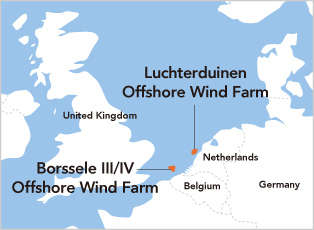
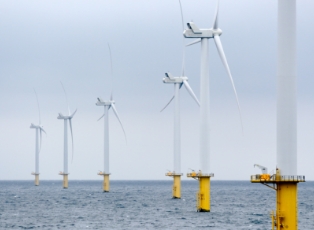
INPEX entered in December 2021 a stock transfer agreement with Diamond Generating Europe B.V. (DGE-NL), a Dutch registered, wholly owned second generation subsidiary of Mitsubishi Corporation, and, after approval by concerned parties, acquired a 50% stake in the Luchterduinen offshore wind farm in February 2022 and a 15% stake in the Borssele III/IV offshore wind farm in March 2022, both operating off the coast of the Netherlands. The Luchterduinen offshore wind farm is located 23 kilometers offshore Noordwijk and has been in commercial operation since September 2015 with an output scale of 129 megawatts produced by 43 3-megawatt units. The Borssele III/IV offshore wind farm is located 22 kilometers off the coast of Westkapelle and has been in commercial operation since January 2021 with an output scale of 731.5 megawatts produced by 77 9.5-megawatt units.
Offshore Wind Power Generation Business in the UK
| Contract area (block) |
Project status | Venture company (established) |
Shareholders |
|---|---|---|---|
| Moray East Offshore Wind Farm | In commercial operation | INPEX Europe Limited (November 17, 2021) |
Ocean Winds 56.6% China Three Gorges Corporation 10% DGL*33.4 %** |
- *Diamond Green Limited (intermediate holding company invested in by DGI)
- **DGI has a 16.7% stake
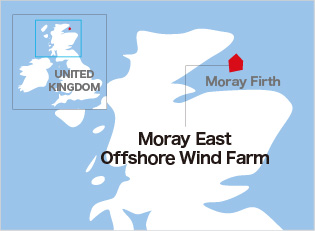
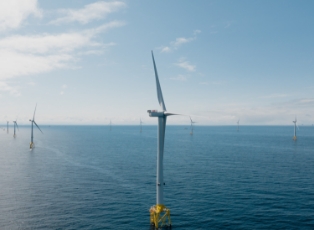
In March 2023, INPEX acquired a 16.7% stake in the Moray East Offshore Wind Farm, which is currently in operation in the Moray Firth, approximately 22 kilometers off the coast Scotland in the UK. The acquisition was enabled through an agreement between INPEX Renewable Energy Europe Limited (INPEX Renewable) and Diamond Generating Europe Limited (DGE), a subsidiary of Mitsubishi Corporation registered in the UK, to transfer stock in Diamond Generating Europe Investments Limited (DGI) from DGE to INPEX Renewable, which was established in the UK to promote INPEX’s renewable energy business in Europe. The Moray East offshore wind farm has been in commercial operation since April 2022 with an output scale of 950 megawatts produced by 1009.5-megawatt units.